In today’s text-driven world, many of us are now turning to messaging apps and social media to communicate with our nearest and dearest.
While we all know there are instances where a phone call is required – such as booking formal appointments, during professional settings and having deeper conversations with family members. But even our rules and etiquette around this has changed, with some choosing to safeguard themselves against the stress of social pressures, and Gen Z experiencing phone anxiety.
To work out how Brits feel about telephone answering, and get to grips with the ‘new rules’ on phone etiquette, we surveyed 1,000 people on an array of gritty phone situations. From the conversations we dread having and the people we routinely avoid answering to…to how many of us are truly answering our phone on the loo…we left no stone unturned!
We delved into…
- How many calls Brits answer and make in a typical week
- The people we’re most likely to answer the phone to (before and after dark!)
- Who we’re least likely to answer the phone to…
- The phone conversations we’re most and least comfortable with
- How many of us answer our phone on the loo (plus five other places we might be likely to pick up)
- The places in which Brits agree it’s inappropriate to answer the phone (and which callers we’ll make exceptions for)
- The agreed new rules on phone etiquette (how many of us actually return missed calls?)
Data shows most Brits pick up at least half of all calls they receive
So first thing’s first…just how many phone calls do Brits answer?
Messages form a huge part of our virtual comms these days, and our survey supported this, showing 53% of Brits with phones prefer texts or Whatsapp messages to phone calls.
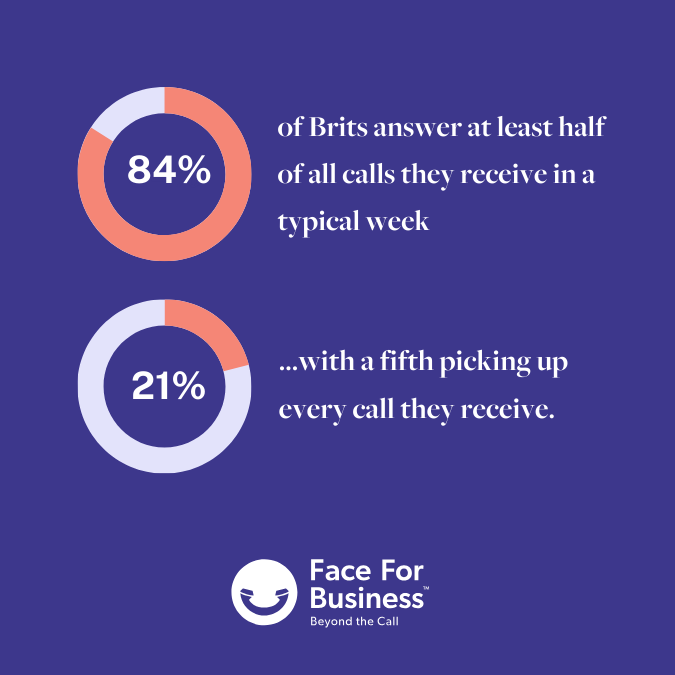
But the humble phone call hasn’t completely fallen out of favour, with 84% of phone-owning Brits answering at least half of all calls they receive in a typical week. And a fifth (21%) go even further, picking up every single call they receive. This increases among Gen Z, who are the most talkative on the phone it seems, with 89% answering at least half of all calls they receive and only 2% admitting they ignore their phone all of the time.
The average Brit makes four phone calls a week (excluding those made in work)
When it comes to how often we’re picking up the phone, our survey showed the average Brit makes around four phone calls a week – not including those made for their work or professional life. While over half (51.2%) pick up the phone between one and five times, almost a quarter (24.4%) make between six and 10, showing phone calls definitely aren’t dead yet.
Friends are ones we’re most likely to pick up the phone to no matter the time of day – trumping partners, children and parents
Friends were revealed to be the callers we’re most likely to answer the phone to, with almost half (45%) of us picking up during sociable hours (8am to 9pm) and 34% during less sociable or ‘after’ hours.
During sociable hours, friends even beat partners, children, siblings and parents as being the most likely to receive a response, while after hours, friends are on-par with partners (34% equally) and remain above parents and siblings (29%).
Top 5 people we’re most likely to pick up the phone to:
- Friends – 45% during sociable hours, 34% during unsociable
- Partners – 34.5 anytime of day
- Children – 34% anytime of day
- Siblings – 30.5% anytime of day
- Parents – 30.5% anytime of day
Exes and unknown numbers least likely to receive a response, both during sociable and after hours
An ex was the least likely to receive an answer, no matter the time of day, with only 5% of the population saying they’d pick up during sociable hours and 6% after hours. They were even less important than unknown numbers (with 8% saying they’d pick up to these during sociable hours and 6% after hours).
Top 5 people we’re least likely to pick up the phone to during sociable hours:
- An ex – 5%
- An unknown number – 8%
- My neighbour – 15%
- A colleague – 18%
- My boss/manager – 18%
Top 5 people we’re least likely to pick up the phone to after hours:
- An ex – 5.5%
- An unknown number – 5.8%
- My boss/manager at work – 8.1%
- A colleague – 10.8%
- My neighbour – 14.1%
Breaking up, handing in notice and having phone sex are among phone conversations we’re least comfortable with having
Among phone owners, sharing good news is the most likely reason they’ll hop on the phone, with 44% saying this is the conversation they’d feel most comfortable having this way.
This is followed by discussing a medical issue with their doctor (29%), calling in sick at work (26%) and apologising to a friend or family member (23%).
Phone sex and breaking up with a long-term partner are convos phone-owners feel least comfortable having (6% each). When it comes to breaking up with somebody they were casually dating though, stats are higher, with 9% of phone-owners being willing to do this.
Phone sex was so unpopular, in fact, that many phone-owners indicated they would rather have a plethora of other types of conversations instead – including hand in their notice (7%), fake a sick day (11%), give complex instructions (13%) or give bad news to a friend or family member (17%).
Top 5 conversations phone-owners feel most comfortable having on phone:
- Sharing good news with friend or family member – 44%
- Discussing medical issue with doctor – 29%
- Calling in sick at work – 26%
- Apologising to partner, friend or family member – 23%
- Sharing news of a deceased loved one – 20%
Top 5 conversations phone-owners feel least comfortable having on the phone:
- Phone sex – 6%
- Breaking up with a long-term partner – 6%
- Handing in notice at work – 7%
- Complaining about their boss – 9%
- Breaking up with a short-term/non-serious partner – 9%
Over 1 in 6 phone-owners admit to answering calls on the toilet
In today’s phone-obsessed society, calls don’t always come at a convenient time, and perhaps more importantly – our choice of when to answer them may not always be convenient for others, either.
Through our survey, we uncovered the various scenarios in which Brits are willing to pick up the phone…as well as which ones they perceive as most or least appropriate.
Perhaps unsurprisingly(!) over one in six Brits with a phone (17%) admitted to having answered their phone on the toilet, with millennials being the most guilty (21%).
And almost one in 10 of us (9%) say they regularly answer calls in the shower, for which both millennials and Gen Zs are more guilty (12% and 19% respectively).
When answering on the toilet, guilty respondents name their partners (31%), best friends (28%) and parents/step-parents (21%) as being the most likely callers.
Brits with a phone were least likely to answer calls while at the theatre or church (3%); at a funeral, when meeting with their child’s teacher or at a job interview (4%), on a first date, during sex with a partner or at a wedding ceremony (5%).
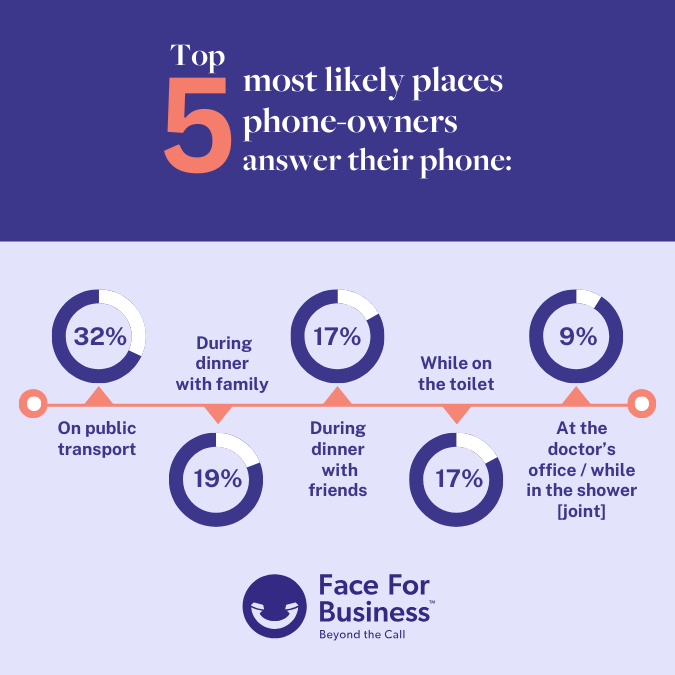
Top 5 most likely places phone-owners answer their phone:
- On public transport – 32%
- During dinner with family – 19%
- During dinner with friends – 17%
- While on the toilet – 17%
- At the doctor’s office / while in the shower [joint] – 9%
(32% of phone-owners responded they never answer their phone in any of the scenarios listed.)
Brits agree on least appropriate places to answer the phone – but stats show we may be breaking our own ‘rules’
When asked in which places or scenarios they think it’s appropriate to answer their phone, most Brits agreed the least appropriate places were during sex with a partner (with only 3% saying it is appropriate), a funeral ceremony (4%), first date (4%), while watching a stage show at the theatre (4%) and when meeting with their child’s teacher (5%).
30% agree it’s fine to answer their phone on public transport, with 16% also believing it’s fine to answer during dinner with family, 14% during dinner with friends, 13% at the doc’s office and 12% on the toilet.
But when it comes to actually doing these things, stats show many of us are willing to break our own rules on what’s appropriate – with 32% answering on public transport, 19% during dinner with family, 17% during dinner with friends, and 17% on the toilet (the biggest discrepancy).
7% have also answered during a work meeting, despite only 5% saying this is appropriate, while 5% have answered during sex with a partner though only 3% say this is appropriate.
Top 5 least appropriate places to answer the phone, according to Brits
- During sex with a partner
- During funeral ceremony
- On a first date
- Watching a stage show at the theatre
- During meeting with child’s teacher
Ill-timed phone calls from partners, parents and best friends seen as most acceptable to answer
When it comes to answering the phone in less favourable situations, perhaps more interesting is who we believe it’s appropriate to answer to.
For example, while sex with a partner is seen as the least appropriate scenario to answer the phone, a quarter (24%) of those who believe it is appropriate say an ex is fine to answer to, as well as unknown numbers. Meanwhile, a fifth (21%) think it would be okay to answer to their parent or neighbour. And while only 12% think it would be okay to answer to their best friend in this scenario, this caller is the most likely to actually have received an answer, by a quarter (23%) of those who have been in this situation.
Among those who believe it is appropriate to answer the phone during a funeral ceremony, partners and parents are most likely to be approved (31%), followed by a best friend or extended family member (22%).
Among those who think it’s appropriate to answer calls on a first date, 31% think it’s fine to answer to a sibling, 28% to their best friend, 26% their neighbour and 23% to their boss/colleague.
And among those who think it’s appropriate to answer the phone during a work meeting, a partner is believed to be the most acceptable caller (by 34%), followed by a friend (23%) their boss or another colleague (23%) and a parent or sibling (21%).
Almost half of phone-owners would prefer a text to check their availability before calling, while 42% prefer waiting for calls to go to voicemail
And finally, just what are the new ‘rules’ when it comes to calling loved ones, and how can we maximise our chance that the person will actually answer?
Well when it comes to unexpected phone calls, the consensus is that they’re a no-no, with almost half (49%) of phone owners saying they dislike or would dislike a call they’re not expecting, and 54% saying they’d prefer the caller to send a text beforehand to check their availability before calling.
Meanwhile, when it comes to pretending ‘nobody’s home’, 42% of phone-owners say they prefer waiting for calls to go to voicemail to see who it is before picking up. And when it comes to returning a call that’s been missed, 55% of phone-owners agree that in the event of a missed call, they would always call back at the earliest opportunity.
Finally, despite the global pandemic making us all too familiar with video calling over the past few years, it seems they’re not likely to replace traditional phone calls anytime soon. When asked if they prefer video to regular phone calls, only 27% of phone-owners say they do, while 46% say they actively don’t prefer them. The main exception for this is Gen Z, 42% of which say they do prefer them vs. 28% who don’t.
Conclusion
While the humble phone call has been declining in popularity over the years, research shows it’s not going anywhere anytime soon,
As our survey shows, in some circumstances, only a phone call will do if a real face-to-face conversation isn’t possible – for example, when sharing good news, apologising or resolving conflict, or discussing a health or medical issue.
Who is on the other end of the phone also plays a key role in how often we pick up, but for friends, partners, parents and children, who are all key people in our lives, phone calls help us massively to stay in touch with and ensure they are safe – especially after-hours.
In a world more connected than ever, perceptions and boundaries on when it’s appropriate to answer the phone are also ever changing, especially across generations.
While Gen Xers, Baby Boomers and the Silent Generation seem less likely to pick up their phone while in company or doing personal things like using the bathroom, younger generations like Gen Zs and Millennials don’t seem to be as discerning, and are more likely to answer a call even in a less-than-convenient scenario.
Meanwhile, though people may be more choosy today over who they answer the phone to, these survey results show phone calls are still valued, with over half of phone-owners (55%) always endeavouring to return any missed calls and 46% saying they actively still prefer them over video calls. When it comes to calling younger generations like Gen Z or Millennials, callers can perhaps think about sending a text as a precursor to a phone conversation to protect their time, but not necessarily as a substitute.
When it comes to doing business, a UK telephone answering service like Face For Business removes all the guesswork of phone etiquette, ensuring customer calls are answered every time without fail.
Methodology
FFB commissioned a survey of 1,000 Brits, including those with and without phones, in July 2024. Survey questions consisted of multiple choice answers, with the option to provide additional qualitative data where needed. Respondents were split by age group, generation, region, city, professional sector and household/parental status.
Raw survey data can be found here: https://bit.ly/ffb-survery-data
18th December, 2024
Posted by Face For Business