
In today’s business world, the most successful organisations are the ones that are able to operate in an agile manner, adapting to changing circumstances without becoming distracted or losing momentum towards their goals.
Ultimately, it’s about having the right business processes, systems and services in place that can adapt to the surrounding environment both internally and externally.
Business process outsourcing (BPO) is becoming increasingly popular among organisations that are looking to stay agile, without sacrificing how they work. Some 70% of UK businesses said they were already outsourcing processes in a 2019 YouGov survey.
If done properly, with the correct research and smart implementation in the right areas, outsourcing certain functions can help your business to remain agile, freeing up time and resources to put back into your core functions. BPO also enables you to bring expertise into other areas of your business more effectively.
In this guide, we’ll take you through everything you need to know about business process outsourcing, so you know what to look for, what to ask, and how to bring in the right resources.
What is business process outsourcing (BPO)?
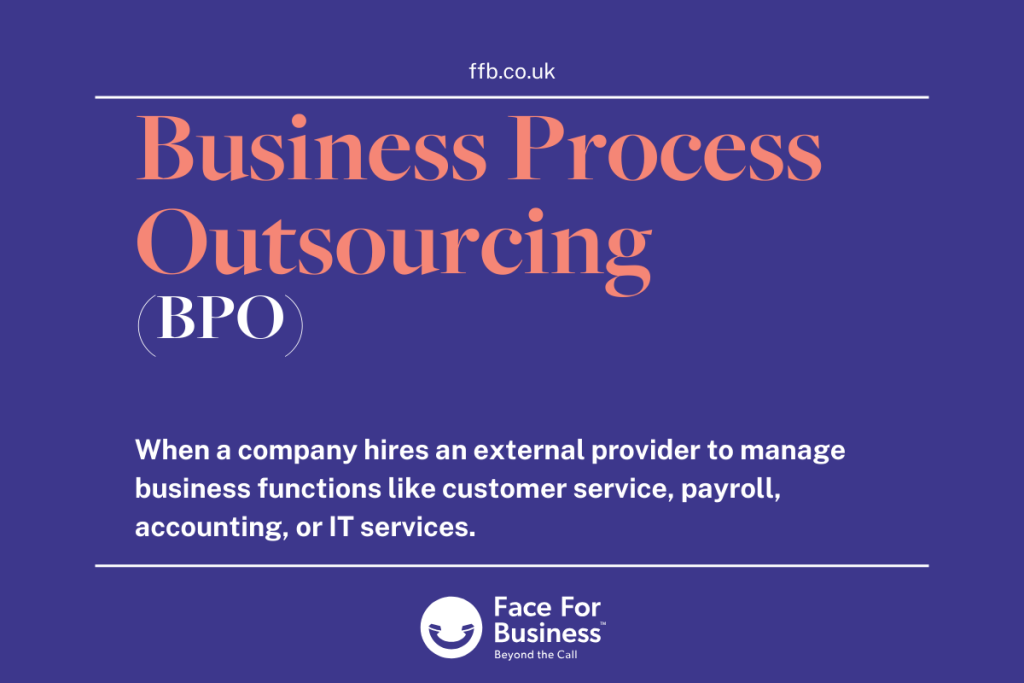
Business process outsourcing or BPO is the act of contracting a specific business function to a third party with particular expertise in that area. BPO often refers to IT outsourcing, but it can also encompass HR support, payroll, marketing, telephone answering and diary management.
Typically, an outsourced function is one that would largely be carried out the same across any organisation and doesn’t require any specific expertise in the outsourcer’s industry (although there are some industry-specific outsourced functions).
What are the different types of business process outsourcing?
There are several different types of business process outsourcing:
- Front office BPO: the outsourcing of ‘front’ or customer-facing services or processes
- Back office BPO: engaging a third party to handle non-customer or client-facing processes
- Onshore BPO: the outsourcing of key business processes to an external provider based within the same country. This is also sometimes known as local BPO or domestic BPO
- Nearshore BPO: this involves hiring a partner from a neighbouring country or locale to manage some business processes
- Offshore BPO: this is when an overseas provider is hired to handle some processes
Each type of business process outsourcing has its own pros and cons. For example, offshore BPO may be cheaper, but onshore BPO will have the advantage of more local market knowledge.
Who can benefit from business process outsourcing?
Business process outsourcing plays a vital role in many organisations, but is particularly beneficial to those that require specific expertise, without necessarily having the budget or resources to bring them in-house. By outsourcing these important functions, businesses can put more focus on their core services and objectives.
In recent years, the need to be agile, lean and focused on key services has been thrown onto centre stage. Focus on revenue-generating activities, business development, growth and future planning have become the order of the day for companies looking to survive the challenges of the next decade. Anything outside of those key functions is primed for outsourcing.
5 benefits of business process outsourcing
If managed properly, BPO can have multiple benefits for organisations, from reducing spend to increasing agility. Here are the key benefits of business process outsourcing:
1. Access extra resources faster
Hiring staff for specific business functions can take a long time, from advertising to interviews to waiting out notice periods before candidates can start – and that’s assuming you manage to fill the position successfully.
Outsourcing business processes means you can access additional resources quickly, without the need to undertake a lengthy hiring process.
2. Increase flexibility
Many outsourced services are highly flexible with the level of service you can get. If you need more, you just pay more and then scale it down again later on. At Face For Business, we only charge for the call answering time you actually use, so if you use fewer minutes one month, that’ll be reflected in your billing.
Hiring staff internally is much less flexible – you have to pay their wages regardless of how busy you are.
3. Reduce costs
Recruiting new staff can also be an expensive proposition; not just in terms of salary, but with all of the other associated costs and overheads too. What’s more, costs like sick pay, holiday pay, insurance, pension contributions, training budgets all add up when you hire resources in-house. This can take money away from your primary business functions, potentially putting your future growth at risk.
When you go down the BPO route, you don’t take on the costs associated with hiring staff like salary, holiday pay, sick pay and tax. You also won’t have any of the admin that comes with having employees or training. Instead, you simply pay for the expertise you need and judge the level of service on the results you get.
4. Focus your expertise
Outsourcing business functions you don’t have expertise or resources for – whether it’s call answering, accounting or marketing – means you can put more of your focus into delivering your primary business function.
While there’ll still be some oversight into the service you’re getting from an outsourced business, you can operate it with a light touch if you’re happy with how things are progressing.
If you were dealing with these functions in-house, you’d be more responsible for them, so would need more oversight on any issues that come up. This can pull your focus away from your primary business function and goals, potentially putting them at risk.
5. Widen your talent pool
Although remote working has opened up the talent pool for many organisations, this can be very role-specific, and lots of businesses are still reliant on the talent pool within their local area, which can be limited.
Business process outsourcing opens your company up to a much wider pool of expertise, helping you to access the level of services you need to improve your business.
Common BPO challenges
It’s natural to feel a little unsure about business process outsourcing if it’s something you haven’t previously explored. Company owners tend to share some common worries, which we’ve broken down below to reassure you that these initial BPO challenges can soon be overcome.
1. Loss of control
One of the key reasons some business owners are reluctant to embrace BPO is because they fear losing control over a part of their company. This is understandable if you’re outsourcing a customer-facing function like customer service or marketing, as how your outsourced business acts reflects on you.
This is why you need to do your research to make sure you end up with the right provider with the skills and experience to match the service you expect. Remember that your outsourced company’s reputation is hanging on their service too, so you can trust them to deliver for you.
2. Hidden costs
Sometimes, you might take on an outsourced company and suddenly find yourself facing costs you weren’t expecting. Maybe they had a minimum monthly fee you weren’t aware of, or higher fees if you surpass your monthly quota for services.
This is why you need to do your research beforehand and be clear with your service provider exactly what fees you’ll be paying per month and what extras might come up. Face For Business’ telephone answering service is priced to the second and all of our packages are fully transparent, so you’ll simply pay for the time you use each month.
3. Security risks
Security risks can be a concern with business process outsourcing, particularly with the likes of IT service providers that might be managing sensitive commercial or customer information online.
You should always consider the privacy or security risks that come along with hiring a third party provider. For example, if they’re a customer-facing function, like business call answering, are they understanding of privacy requirements and confidentiality? At Face For Business, our call handlers will spend time getting to know your business and exactly how you need calls to be answered as part of your onboarding to put these concerns at ease.
4. Quality control
Quality of service is one of the biggest concerns business owners have when it comes to outsourcing, especially for customer-facing functions. How can you monitor the quality of the service coming from your outsourced provider, and what impact is that service having on your own reputation? Checking previous testimonials and case studies is one way to judge the level of service you’ll get, but does the company have any means of demonstrating success to you during the contract?
For instance, an outsourced marketing agency should be able to demonstrate the amount of leads they’re generating for you. Similarly, a call answering provider should be able to provide full recordings so you can listen and judge the quality of the service you’re getting.
If your potential BPO partner struggles with proving the quality of their work, maybe reconsider.
5. Potential disruption
There’ll come a time when you and your outsourced service provider will part ways – hopefully on good terms. But while relationships can last a long time in business, sometimes you’ll need to move to a new provider simply because your existing service got stale and you needed a change.
So what will happen when it does come time to part ways? Will there be any penalties if you decide to leave before the end of your contract? Will you get any support in transferring the service over a new provider or will you have to manage it all on your own? It’s worth asking the question to eliminate these understandable BPO concerns.
6. Lack of flexibility
Flexibility of resources is one of the key benefits of business process outsourcing, meaning you can simply pay more for a higher level of resource during busy periods and scale back when it’s quieter. However, not all third party providers are this flexible.
Check what your service agreement is and that you have the flexibility you need built in when outsourcing a new process – if it’s not there, look for a provider that offers the flexibility you need. For example; if you use a phone answering service, can you adjust your contract to a lower level during off-peak periods?
How to know what to outsource in business: key considerations
Business process outsourcing isn’t just a case of picking a business function you don’t particularly want to deal with and finding someone else to deal with it. You need to approach BPO strategically and with the purpose of improving your business.
When deciding which functions to outsource, there are some key points to consider, which we’ve outlined below.
1. What resources do you need?
Do you need someone to come in and take over a complete function, or do you just want some help with overflow during busier periods? Understanding this will help you find the right provider and prevent you from overpaying for excess services you don’t need.
2. What’s your cash flow like?
While you shouldn’t skimp on your outsourcing, as it’s true that you get what you pay for, you don’t want to outsource a function that will then put your cash flow at risk. Start by reviewing your current cash flow carefully and use this as a basis for what you can afford.
Keep in mind that your outsourced services should free you up to focus more on revenue generation, so consider the increased revenue you’d expect to generate and compare this to the costs of BPO.
3. What business processes do you have?
Understanding your current processes and how they’re operating will help you to decide which services you need to access externally. It will also help you to prioritise your outsourcing if you need to outsource more than one thing. For instance, many businesses automatically choose to outsource their finance and accounting simply because they don’t have the skills, but you should also look beyond the more obvious functions.
4. What suppliers are available?
Finally, you need to thoroughly review the suppliers that are available in the areas you want to outsource. Some areas are saturated with suppliers, but other functions are more specialised, and you might need to do a bit more digging into who’s available. Then, you can start to think about your outsourcing options.
5. Should you outsource some or all of the work?
This question should fall within your resource planning. You might be able to deal with the majority of the calls that come through to your business, but you may need some additional resource to manage the occasional overflow, or to introduce evening and weekend call answering.
On the other hand, you might be completely overwhelmed with the volume of calls coming to your business and need an outsourced call handling service to manage all incoming calls. Assess your current situation and what would be most helpful when deciding what to outsource.
6. How will BPO impact your bottom line?
Measuring your ROI from any outsourced service is key in deciding whether it’s worth bringing in outsourced services or hiring in-house. Sometimes, it might make sense to hire internally if the associated costs are lower than the costs of outsourcing. This very rarely happens though; you’ll often find that the outsourcing fees are substantially lower than hiring in-house, or they provide much better value.
Hiring a receptionist to deal with phone calls can easily cost upwards of £30,000 a year in salary, plus tax, pensions, sick and holiday pay and the other associated costs and admin. Compare that to a dedicated phone answering service that either charges for a set time a month or by the minute, and the costs of business process outsourcing will be substantially less.
7. What would happen if you did nothing?
Finally, you need to ask yourself what if you didn’t outsource and simply carried on as normal? What would the risks be if you continued to struggle managing resources in-house, rather than making the investment in experts who could help your business? How would that impact your ability to create a more agile business? And how would that impact your ability to adapt to the challenges you’ll face in the future? Consider each of these points before making any BPO decisions.
6 business processes to consider outsourcing
Below are some of the most common business processes to consider outsourcing:
1. Payroll & taxes
Many organisations outsource their finance roles to third party-providers, because most company owners – especially small business owners – don’t have the expertise to deal with these areas. They also don’t have the time to dedicate to taxes when they need to keep their revenue coming in.
Bookkeeping and accounting fit perfectly into the BPO model because they’re a specialist skill that can be subject to yearly increases and declines in usage.
2. Human resources
HR is a critical business function – sometimes, it can be beneficial to keep this in-house for serious cases. But for the most part, HR can be effectively outsourced because it takes a huge amount of time and administration off your hands, leaving you to focus your expertise elsewhere. That time saved can be well worth the return on investment.
3. IT support
IT support was the most commonly outsourced business function, according to YouGov’s 2019 poll, which found that 34% of respondents outsource this expertise. IT is a constantly changing area of expertise that requires specialist knowledge and understanding that most business owners can’t be expected to keep up with, making it a prime candidate for outsourcing.
4. Marketing
Marketing is seen as a contentious area for outsourcing by some business owners who worry that an external agency won’t be able to communicate the company’s message or USP as well as an internal resource could. But bringing the same level of marketing expertise and execution in-house is incredibly expensive compared to outsourcing to an agency.
While you could spend £30,000 on a marketing executive, they likely won’t have the depth of knowledge of web development, SEO, PPC, content creation and strategy that you could get for the same amount with an agency.
5. Seasonal support
If you have seasonal peaks or the need for temporary extra resources, then you’ll likely benefit from the support of an agency that can supply temporary staffing. In this situation, BPO can be much more effective than hiring a team of full-time staff who you only use properly half of the year.
6. Call answering
With the changing way we work, the adoption of remote working and lesser reliance on an office and fixed reception, telephone answering is increasingly becoming a cost-effective, popular function to outsource.
Which business processes should be kept in-house?
There will be some parts of your business that you need to keep under your control. You may be able to outsource some roles within these functions, but you’ll still need internal expertise. With this in mind, here’s what you absolutely shouldn’t outsource.
1. Core competencies
Core competencies refer to the primary service your business offers. These are specific skills that relate to your organisation and require deep knowledge that you couldn’t get from a third party.
For example, a garden centre may bring in an agency worker to work the tills over the summer, but wouldn’t outsource the main role of a grower or gardener. Or a dermal filler who evens out wrinkles might outsource their call answering and diary management, but they’re not going to outsource the work itself.
2. Fundamental business problems
Every business will go through challenges and issues, and it can be easy to try and shoehorn an outsourced provider into your company to try and deal with the problem. But outsourcing fundamental business problems to someone else rarely solves them, because they’ll be so specific to your company.
While you can bring in expertise to lean on and ask questions, you ultimately need to come up with the solution for your own company.
3. Serious HR
Sure, you can outsource some functions of human resources like holiday booking. But when it comes to HR issues like conflict resolution or serious allegations between employees, you need to keep decisions internal.
Yes, you can bring in specialist advice, but outsourcing the problem to someone else could have consequences further down the line if you’re deemed to be ignoring serious problems in your own company.
4. Management
You need key personnel in your business who understand the way the organisation works and its direction, which means management isn’t the wisest function to outsource.
We all believe as business leaders that we understand and know our businesses best, and the staff around us will learn from us over time, reflecting our goals and ambitions, so consider this carefully before turning to BPO.
5. If the cost is higher than employing the resource
If you need to outsource a role or task and it costs you more to outsource than employing someone yourself, this needs to be considered carefully – any business process outsourcing decisions need to make business sense. If the costs are high, it might make sense for the short-term, but perhaps not the long-term.
What are the downsides of keeping all business processes in-house?
As your business grows and you become busier, you’ll find yourself being dragged from task to task, problem to problem. The risk of trying to manage everything yourself is that your focus will become too split and you won’t accomplish anything particularly well.
Bringing competencies and functions in-house might seem like you’re delegating, but you’ll now be responsible for overseeing those functions and managing the people – and associated admin – behind them.
If you started your business to focus more on delivering the services you have expertise in, this extra work can feel like a burden. Business process outsourcing can take this away.
How to choose the right vendors for business process outsourcing
What’s the best way to find and choose the right vendors to provide your business with outsourced services you can trust? Here are five key points to consider:
1. Type of support required
Start by thinking about exactly what you need from your outsourced vendor, and assess whether each vendor’s services match your requirements. Be very specific, as this will determine whether you’re getting the level of service you need.
You might recognise that you need telephone answering support. But what kind or level of support? Are you in a niche where a specialist call answering service would be more beneficial? These are all important points to consider.
2. Case studies & testimonials
Often, the only way to find out whether an outsourced provider can deliver is to hire them. But you can get a good idea about the level of service you can expect based on the company’s testimonials and case studies. Check your supplier’s website or Google reviews, and bear in mind that if they don’t have any, they might be a new company, so take this into consideration too.
3. Specialist experience
Within your particular industry, there will always be areas of specialist knowledge and skills. If you need a particularly niche skill, can your outsourcing partner deliver or are they more of a general supplier? The answer to this will help you to determine the provider you bring in – although it could also affect the price.
4. Contract terms
Before you sign up to use any third-party supplier, make sure you understand exactly what you’re signing up for. This doesn’t just include the services you’ll get, but any clauses in your contract that could bite you later on. For example:
- Do they have a minimum service level that you’ll be charged?
- Do they have an automatic renewal period for services that you need to be aware of?
- What are their terms for early cancellation of services?
5. Flexibility
Much like the contract terms, understand how flexible the level of services are that you can get as part of your BPO contract. Are you signing up to a fixed monthly service, or is there flexibility in the service levels you can get from month to month?
Look into whether you can scale up for seasonal peaks, or whether they offer ‘full service’ functions. Marketing is one example, with many services from SEO to social media to brand design falling under that umbrella. If you need more than one of these functions, consider bringing more services under that provider to save on admin and potentially reduce costs further.
However, be wary of any provider that tries to take over as many functions as they can. The best business process outsourcing providers will understand the benefits to you of keeping some services in-house and won’t just try to take as much of your money as possible.
Why many businesses outsource telephone answering
Call answering is a business function that’s ideal for outsourcing, arguably more so than ever. With more businesses ditching offices and physical receptions, it’s making less sense to have a full-time member of staff purely to answer the phone – particularly when full-time receptionists can cost around £30,000 a year in base salary. And that’s not to mention the benefits, taxes and admin that comes with having a full-time or part-time receptionist, who can only deal with one call at a time.
A virtual answering service can solve this problem, helping you to make sure you never miss an incoming call. At Face For Business, our call handlers can take messages and send them immediately to the relevant person in your company, or automatically forward emergency calls to you. They can also act as a screen between your busy employees and unsolicited sales calls that take them away from value-adding, revenue-generating tasks. If you need additional support with admin tasks like diary management, you can use your virtual receptionist to help you manage this too.
Want to start seeing the benefits of business process outsourcing from a provider that can easily deal with your customer enquiries when you can’t get to the phone? Face For Business’ professional call handlers are trusted by 100s of businesses to deal with their incoming calls. We also provide a virtual receptionist service to deal with other tasks like diary management and meeting bookings.
Stop worrying about missing calls while you’re running a business, and invest in a reliable outsourced answering service you can trust. Contact us today for more information or to start your 7-day free trial.
04th November, 2021
Posted by Face For Business